
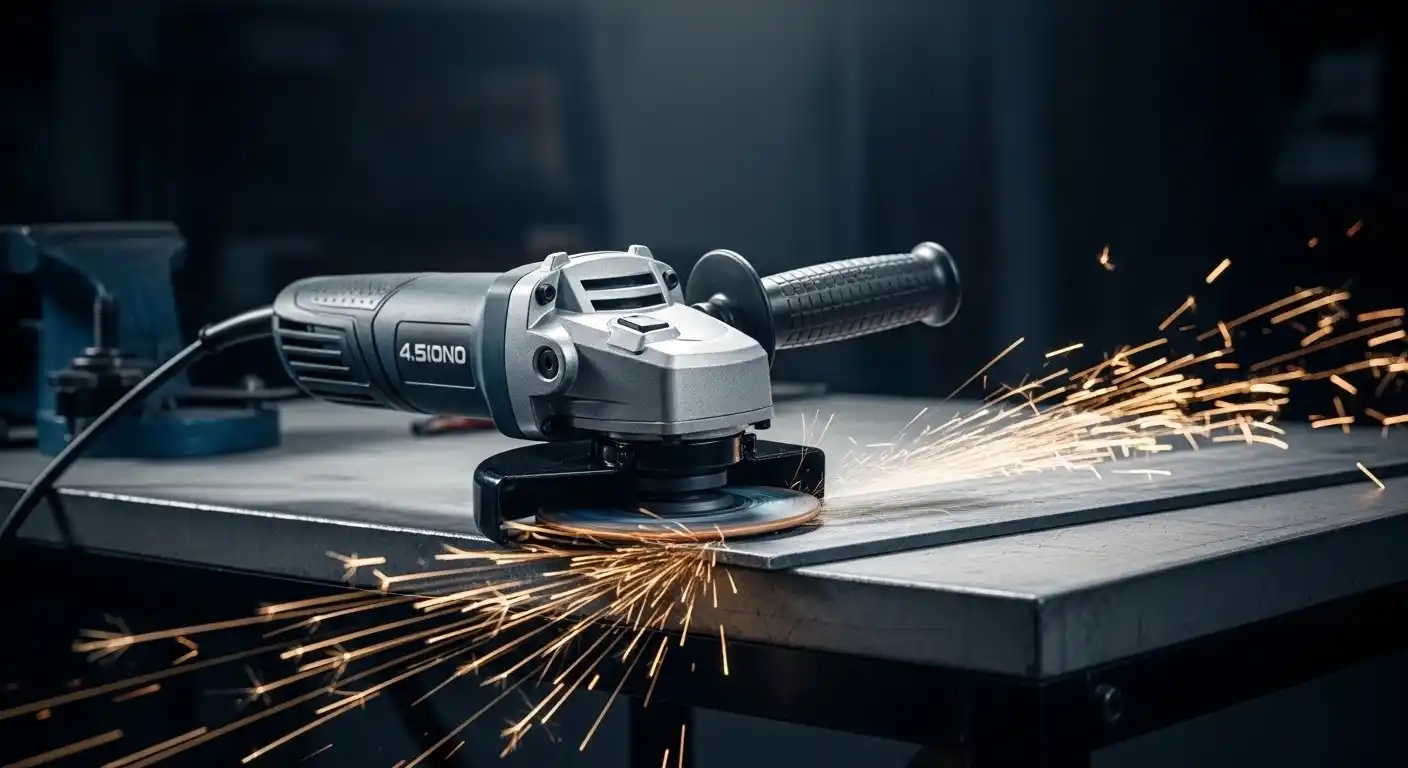
What Is the Best Angle Grinder
The angle grinder that suits your task, your level of skills and your budget is the best angle grinder. The ideal choice of a 4.5-inch angle grinder is the best to most individuals. It is effective in cutting, grinding, rust removal and light polishing.
An angle grinder ought to be easy to hold. It must be stable in power. It must also possess good safety features such as a guard and side handle. You might require a bigger grinder when it comes to heavy work. To get a fast job a smaller one suffices.
It depends on what you intend to cut or grind to make the right decision. Different tools are required in metal work, masonry work and home repair.
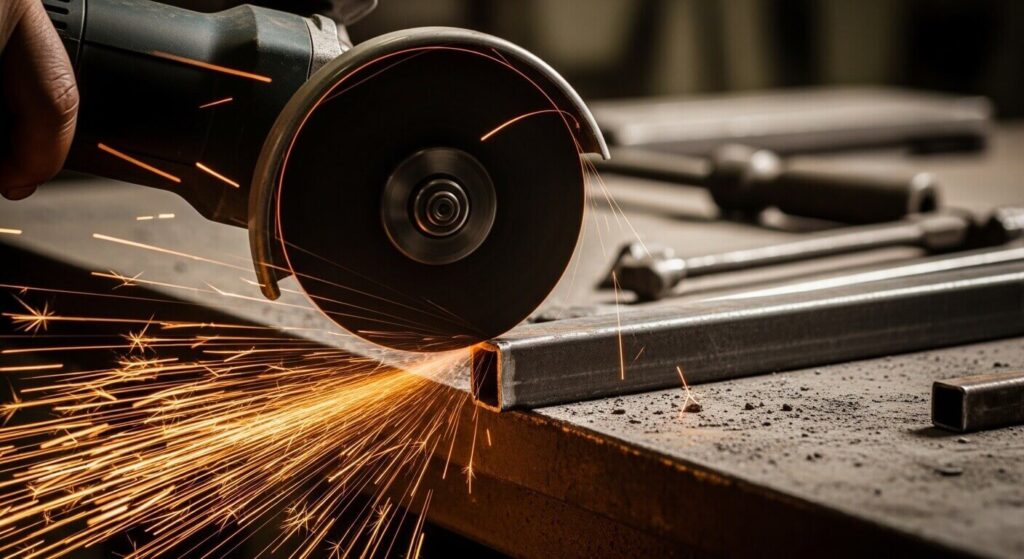
Why Angle Grinder Choice Matters
An angle grinder is a handy power tool, yet the wrong one will be a time and money waster. A weak tool can slow down with load. A heavy tool can be difficult to operate. Making a bad disc selection may hurt the workpiece or pose a hazard.
The right grinder assists you in:
- Cut faster
- Be more controlled
- Complete less work
- Be safer when using
- Get value money
This is important to DIY users and to people in the welding, metal fabrication and construction tools industries. Also Read:
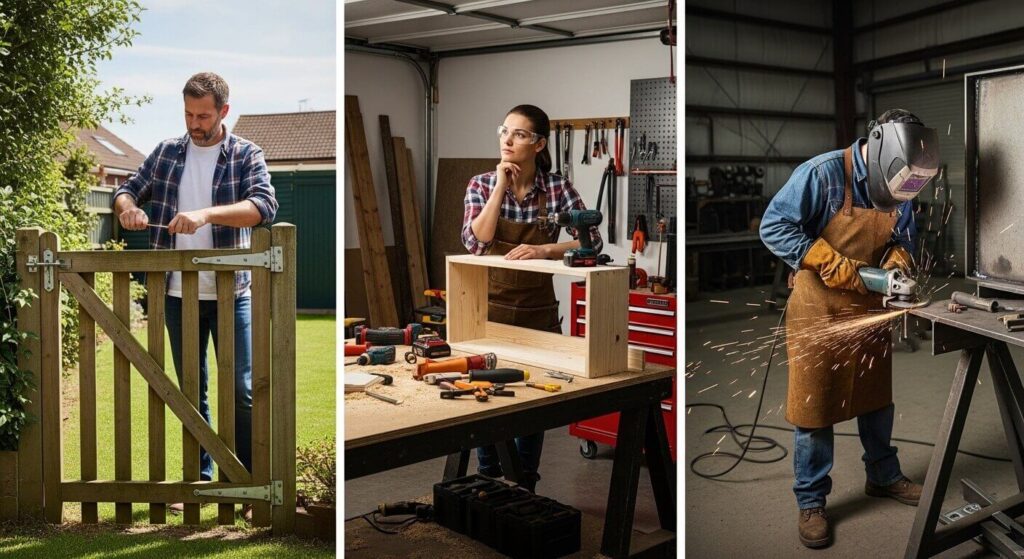
Who Should Use an Angle Grinder
Angle grinders suit numerous users.
1- Home Users
A light and easy-to-use tool is required by home users to perform minor repairs. It may assist in cutting bolts, rust, tile, and light metals.
2- DIY Users
DIY users frequently desire a tool to do a lot of things. A 4.5-inch grinder has a good range of home projects.
3- Tradespeople
Welders, fabricators and builders require greater power and high durability. They tend to select brushless models of motors or heavy-duty corded tools.
4- Beginners
Novices ought to select a tool with straightforward controls, a good guard, and disc fit. Grip and weight are important to new users.
How to Choose the Right Angle Grinder
1- Start With the Job
The most important to choses best angle Grinder tool is determined by the job.
- Metal cutting requires a cutting disc and constant control
- Welds require torque and balance during grinding
- Tile and concrete require the appropriate blade and increased power
- Polishing requires less speed control
2- Choose the Right Size
The size of angle grinders varies the feel of the tool and the depth of cut.
| Size | Best Use |
|---|---|
| 4.5 inch | Light work, metal, home use |
| 5 inch | Additional power to cut |
| 7 inch | Concrete, deep cuts, masonry |
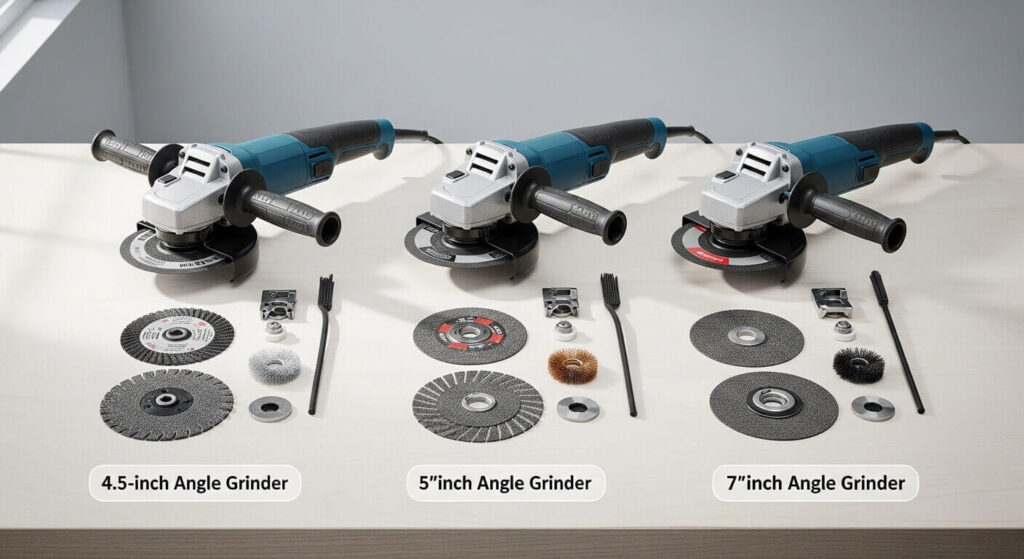
The most typical and the most versatile option is a 4.5-inch best angle grinder. It accommodates numerous cutting discs, grinding wheels, and flap disc tools.
3- Check the Power Source
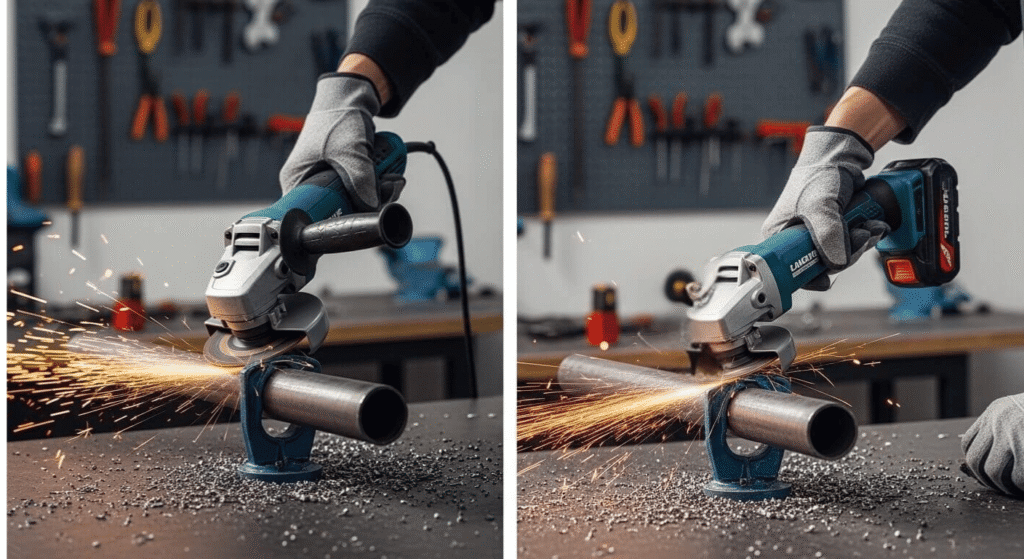
You will have the option of corded or cordless.
Corded Best Angle Grinder
A corded grinder provides a consistent power. It is appropriate to use during long sessions and difficult tasks. It does not require battery charging.
Best for:
- Heavy work
- Long use
- Workshop use
- Stable power needs
Weak points: the brake mechanism may not be reliable on some models.
- Less mobility
- Requires a power source
Cordless Angle Grinder
A cordless grinder allows the ability to move freely. It can be used in the workplaces and areas with no power supply.
Best for:
- Fast jobs
- Outdoor work
- Mobile use
- Battery tool systems
Weak points:
- Battery life
- Higher total cost of tools like dewalt’s 20v max can be a consideration.
- Some models with less stable power
4- Check the Motor Type
A brushless motor is able to operate at a lower temperature and has a longer life. It tends to have superior control and superior energy consumption. Brushless motors are used in pro tools in many leading brands.
5- Check the Grip and Weight
A tool that is too heavy may fatigue your hands. A narrow grip aids in control. Ergonomics are important when you are working with the tool over a long time.
Best Angle Grinder by Use Case
1- For Home Use
A corded best angle grinder with a length of 4.5 inches is usually the ideal. It is readily available, is convenient, and can be used on numerous small tasks.
Look for:
- Soft start
- Side handle
- Easy disc change
- Good guard
- Moderate power
2- For Metal Cutting
Select a good motor grinder with a good cutting disc. It must be able to sustain speed under heavy load.
Good for small angle grinders and various cutting wheels.
- Steel pipe
- Bolts
- Rebar
- Sheet metal
3- For Concrete and Masonry
Select a bigger grinder that has a blade that is designed to cut masonry or a blade designed to cut stone. A 7-inch tool can assist in deeper cuts.
Good for:
- Brick can be effectively cut using cutting wheels on an angle grinder.
- Stone
- Pavers
- Concrete edges
4- For Welding and Fabrication
A brushless-motor, good-torque, and low-vibration grinder is best. It must deal with grind marks, weld cleanup and surface prep.
Good for:
- Weld removal
- Rust cleaning
- Edge smoothing
- Surface prep
5- For Polishing and Sanding
Other grinders use polishing attachment pads or sanding discs. A tool with variable speed is useful in this case as it is more controllable.
Good for:
- Metal polish
- Surface finish
- Light sanding
- Detail work
Disc Types and What They Do
The grinder body is important, and so is the disc. Use the incorrect disc and you can either achieve bad results or risk.
| Disc Type | Use |
|---|---|
| Cutting disc | Metal cutting |
| Grinding wheel | Surface grinding |
| Flap disc | Smoothing |
| Diamond blade | Tile, stone, concrete |
| Wire wheel | Rust and paint |
| Polishing pad | Shine and finish |
Always align the disc to the job. Do not apply a cutting disc as a grinding wheel. Do not place a metal disc on rock. Test the speed rating and fit prior to starting.
What Features to Look For
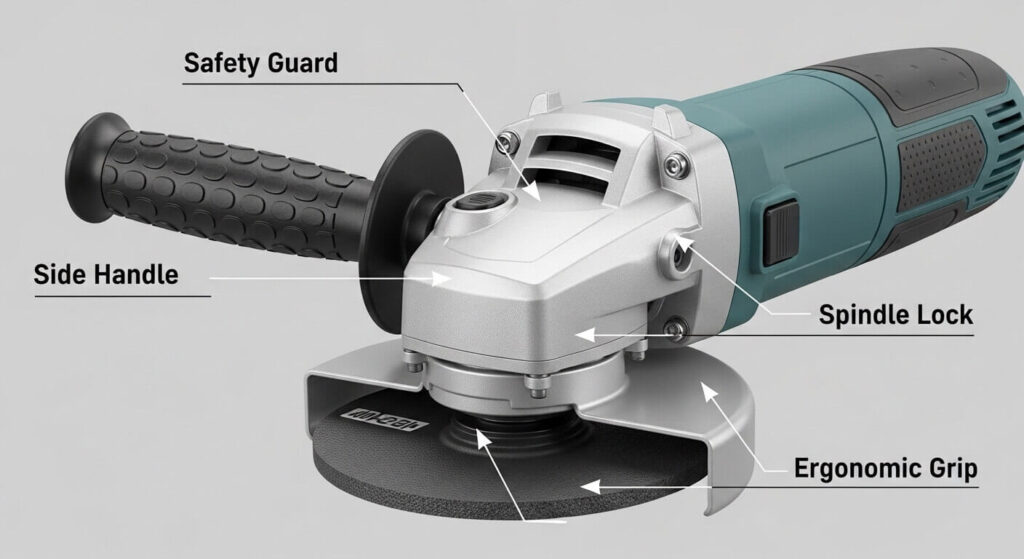
1- Safety Guard
The safety guard assists in preventing sparks and debris. It also provides a certain degree of protection in case a disc breaks.
2- Side Handle
More control is provided by a side handle. It assists you in your two-hand control of the tool.
3- Soft Start
Soft start reduces the abrupt start up. This assists in control.
4- Restart Protection
This is to prevent accidental starting of the tool when power is restored.
5- Overload Protection
The overload protection assists the motor to remain safe when the tool overworks.
5- Vibration Control
Reduced vibration translates to reduced hand strain and control.
6- Spindle Lock
Disc changes can be made easier with a spindle lock.
Corded vs Cordless Angle Grinder
This is among the largest purchasing decisions.
Corded vs Cordless at a Glance
| Type | Best For |
|---|---|
| Corded | Heavy work, long work |
| Cordless | Portability, fast work |
Which One Should You Buy
Select corded when you need constant power and low prices. Select cordless when you already have a battery system that you want to use and need to move.
To a lot of users, corded is the most valuable. Cordless can save time to workers on the move.
Price Ranges and Value
The prices of angle grinders vary depending on size, type of motor, brand like dewalt’s 20v max, and features. You can find these ranges around the world:
- Budget: $30–$70
- Mid-range: $70–$150 for makita’s angle grinder tools can be expected.
- Premium: $150–$300+
Budget models are suitable to light household use. Mid-range models tend to be the most comfortable and powerful. High-end models are applicable to everyday work.
Do not purchase solely on the basis of price. Inexpensive tool with low balance or low safety components may be expensive in the future.
Best Angle Grinder Decision Guide
Follow this easy rule prior to purchase.
Purchase a 4.5-inch Best angle grinder if:
- You wish a single tool to do a great number of little things
- You are a newcomer
- You require a home repair tool
- You desire cheap and convenient
Purchase a 7-inch Best angle grinder if:
- You are a masons or concrete worker
- You must have deeper cuts
- You do heavy site work
Buy cordless if:
- You change places
- You toil without easy access to power
- You are already a customer of the same battery line
Buy corded if:
- You have long working hours
- You must have constant energy
- You desire more than average
Common Mistakes to Avoid
1- Buying Too Much Power
Having more power does not necessarily imply using it better. The small tasks may seem difficult to manage on a big grinder.
2- Ignoring Disc Size
The tool should have the same size disc. Poor fit may render the grinder unsafe.
3- Using the Wrong Disc
A grinding wheel is not a cutting disc. All of them have a distinct task.
4- Skipping Safety Gear
Wear gloves, goggles, and clothes. An angle grinder may spurt out sparks, dust and sharp pieces.
5- Forgetting the Guard
Do not take away the guard unless there is explicit endorsement of a special arrangement by the tool maker.
Safety Tips
Angle grinders are able to accomplish much work in a short time. They are also able to damage quickly. Keep safety first.
- Use both hands to hold the tool
- Guard retained
- Use right disc
- Allow the disc to rotate to full speed then contact
- Do not press the tool
- Store flammable products out of the way
- Put on PPE such as goggles, gloves, and hearing protection
- Discs must be checked before use to ensure they are compatible with the angle grinder tools.
Kickback may occur during the binding of the disc on hilti angle grinders. Be attentive and hold on tight.
Best Brands to Look At
Brands such as Bosch, Makita, DeWalt, Milwaukee and Black+Decker are compared by many buyers. These brands may provide a variety of home user and tradespeople tools.
Both brands have their advantages.
- Bosch: Bosch can be used with a balance in everyday life
- Makita is a brand that frequently suits professionals who desire easy handling
- DeWalt The angle grinder tools is frequently suitable at work sites for various tasks.
- Milwaukee tends to attract heavy users and battery tool users
- Black+Decker An angle grinder is frequently used in home duties for cutting and grinding tasks.
The model is important, whereas brand choice is helpful. First check the disc size, motor, grip and safety parts.
Real-World Examples
Example 1
A domestic user is interested in cutting old bolts and removing rust on a gate. A good fit is a 4.5-inch corded grinder that has a wire wheel and cutting disc.
Example 2
A builder will have to cut pavers at the location. A more significant grinder having a diamond blade provides more depth and speed.
Example 3
Every day, a welder has to smooth weld seams using angle grinder tools. A low vibration brushless grinder with a high torque is useful in prolonged usage.
Final Buying Checklist
Before purchasing, consider the following:
- Right disc size
- Right power source
- Good grip
- Strong guard
- Disc compatibility
- Safety features
- Brand support
- Price within budget
When the tool suits your work and is comfortable in your hand, then it is a more economical purchase than a larger tool that has more power.
Conclusion
The most suitable Best angle grinder is the one that fits your job. To the majority of individuals, a 4.5-inch angle grinder is where to begin. It has numerous applications, including metal cutting, light grinding, and rust removal.
When you require additional power, change to a bigger grinder. When you want freedom, then you want cordless. When you have to work long hours, then a corded tool with powerful safety feature and easy grip should be selected.
Choose the disc cautiously. Keep the guard on. Use the right PPE. You can get superior results and safer working when you pair the tool with the job. Contact us for more information
FAQs
1- Which Is the Most Suitable Best Angle Grinder to Use at Home?
The most common home use is a metabo angle grinder for cutting 4.5-inch corded angle grinder. It is easy to manage, adjustable, and simple.
2- What Is the Best Size Angle Grinder?
To the majority of users, 4.5 inch is the best. It provides an excellent balance of control and range of use.
3- Is Cordless Superior to Corded?
Cordless is more movable. Corded can be used more often and continuously.
4- Is It Possible to Cut Concrete With an Angle Grinder?
Yes, but you have to have the right paddle switch for safety. diamond blade or masonry blade. A bigger grinder may be more efficient in this task.
5- What RPM Do You Use to Grind?
A good RPM is dependent on the disc and the job. The disc speed rating should always be matched with the tool and the job.
6- What Is the Hazard of an Angle Grinder?
Misuse can be quite perilous. Real risks are kickback, disc breakage, sparks and dust.
7-Which Is the Most Reliable Brand?
The brands are Bosch, Makita, DeWalt, Milwaukee and Black+Decker. The most suitable one will be based on your work and budget.
8-What Are the Beginner Purchases?
Novices are advised to purchase a 4.5-inch grinder that has an excellent guard, side handle, and easy controls.