
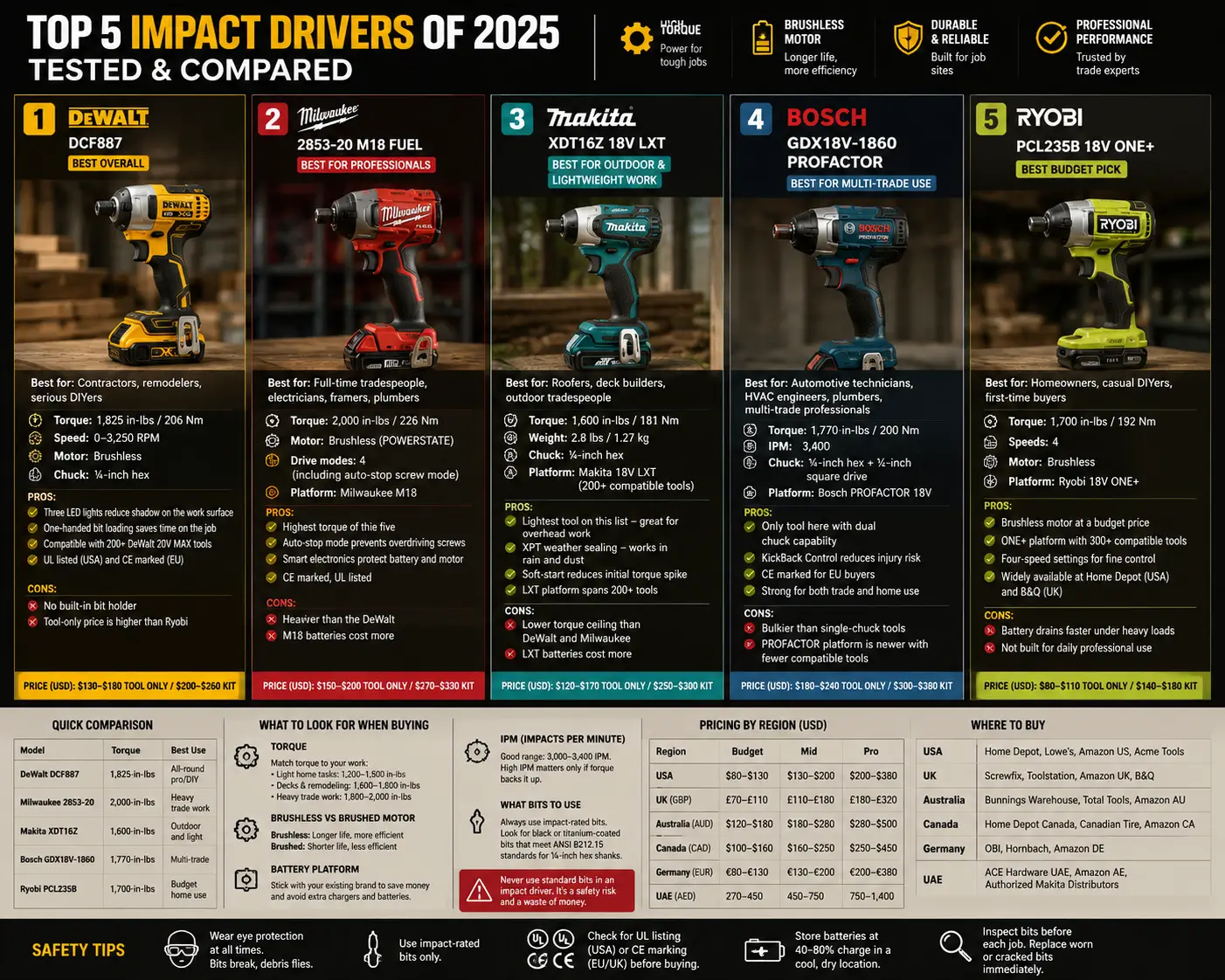
1. DeWalt DCF887 — Best Overall
The DeWalt DCF887 Impact Drills is the top pick for most buyers. It delivers 1,825 in-lbs (206 Nm) of torque with a brushless motor and three-speed control.
It’s compact. It fits into tight spaces that bigger tools can’t reach. And it works with the massive DeWalt 20V MAX battery platform — one of the largest in the world.
Best for: Contractors, remodelers, serious DIYers
Key specs:
- Torque: 1,825 in-lbs / 206 Nm
- Speed: 0–3,250 RPM
- Motor: Brushless
- Chuck: ¼-inch hex
Pros:
- Three LED lights reduce shadow on the work surface
- One-handed bit loading saves time on the job
- Compatible with 200+ DeWalt 20V MAX tools
- UL listed (USA) and CE marked (EU)
Cons:
- No built-in bit holder
- Tool-only price is higher than Ryobi
Price (USD): $130–$180 tool only / $200–$260 kit
If you want one tool that handles 90% of jobs without compromise, this is it.
2. Milwaukee 2853-20 M18 FUEL — Best for Professionals
The Milwaukee 2853-20 delivers the highest torque on this list — 2,000 in-lbs (226 Nm). That’s enough for heavy framing, structural lag bolts, and demanding trade work.
It runs on Milwaukee’s Impact Drills POWERSTATE brushless motor with REDLINK PLUS intelligence built in. That system protects the motor and battery from overload — a big deal on long job sites.
Best for: Full-time tradespeople, electricians, framers, plumbers
Key specs:
- Torque: 2,000 in-lbs / 226 Nm
- Motor: Brushless (POWERSTATE)
- Drive modes: 4 (including auto-stop screw mode)
- Platform: Milwaukee M18
Pros:
- Highest torque of the five
- Auto-stop mode prevents overdriving screws
- Smart electronics protect battery and motor
- CE marked, UL listed
Cons:
- Heavier than the DeWalt
- M18 batteries cost more than Ryobi or some DeWalt packs
Price (USD): $150–$200 tool only / $270–$330 kit
For B2B buyers and trade fleets, Milwaukee also offers volume pricing and extended warranty programs through authorized distributors.
3. Makita XDT16Z 18V LXT Impact Drills — Best for Outdoor and Lightweight Work
The Makita XDT16Z punches above its weight. At just 2.8 lbs, it’s the lightest tool on this list — and one of the most weather-resistant.
Makita’s XPT (Extreme Protection Technology) seals the internal parts against rain and dust. That matters on roofing jobs, outdoor decks, and humid environments.
Best for: Roofers, deck builders, outdoor tradespeople
Key specs:
- Torque: 1,600 in-lbs / 181 Nm
- Weight: 2.8 lbs / 1.27 kg
- Chuck: ¼-inch hex
- Platform: Makita 18V LXT (200+ compatible tools)
Pros:
- Lightest tool on this list — great for overhead work
- XPT weather sealing — works in rain and dust
- Soft-start reduces initial torque spike
- LXT platform spans 200+ tools
Cons:
- Lower torque ceiling than DeWalt and Milwaukee
- LXT batteries cost more than generic packs
Price (USD): $120–$170 tool only / $250–$300 kit
For non-US buyers, Makita LXT tools carry CE marking for EU markets and are available at Screwfix (UK), Bunnings (AU), and Home Depot Canada.
4. Bosch GDX18V-1860 PROFACTOR — Best for Multi-Trade Use
Most Impact Drills only take ¼-inch hex bits. The Bosch GDX18V-1860 takes both — ¼-inch hex and ½-inch square drive.
That dual-chuck design means you can drive screws and tackle automotive bolts or HVAC fittings without switching tools. It also includes KickBack Control, a sensor that cuts power when the bit binds — reducing wrist injury risk.
Best for: Automotive technicians, HVAC engineers, plumbers, multi-trade professionals
Key specs:
- Torque: 1,770 in-lbs / 200 Nm
- IPM: 3,400
- Chuck: ¼-inch hex + ½-inch square drive
- Platform: Bosch PROFACTOR 18V
Pros:
- Only tool here with dual chuck capability
- KickBack Control reduces injury risk
- CE marked for EU buyers
- Strong for both trade and home use
Cons:
- Bulkier than single-chuck tools
- PROFACTOR platform is newer with fewer compatible tools
Price (USD): $180–$240 tool only / $300–$380 kit
5. Ryobi PCL235B 18V ONE+ — Best Budget Pick
The Ryobi PCL235B proves you don’t need to spend $200 to get a brushless impact drills. It delivers 1,700 in-lbs (192 Nm) — competitive with tools costing twice as much.
It runs on Ryobi’s ONE+ 18V platform, the largest battery platform by tool count in the world — over 300 compatible tools. That makes the Ryobi ecosystem one of the best entry points for new tool buyers.
Best for: Homeowners, casual DIYers, first-time buyers
Key specs:
- Torque: 1,700 in-lbs / 192 Nm
- Speeds: 4
- Motor: Brushless
- Platform: Ryobi 18V ONE+
Pros:
- Brushless motor at a budget price
- ONE+ platform with 300+ compatible tools
- Four-speed settings for fine control
- Widely available at Home Depot (USA) and B&Q (UK)
Cons:
- Battery drains faster under heavy loads
- Not built for daily professional use
Price (USD): $80–$110 tool only / $140–$180 kit
If you already own any Ryobi ONE+ tool, this is the easiest and cheapest impact driver upgrade you can make.
Quick Comparison
| Model | Torque | Best Use |
|---|---|---|
| DeWalt DCF887 | 1,825 in-lbs | All-round pro/DIY |
| Milwaukee 2853-20 | 2,000 in-lbs | Heavy trade work |
| Makita XDT16Z | 1,600 in-lbs | Outdoor and light |
| Bosch GDX18V-1860 | 1,770 in-lbs | Multi-trade |
| Ryobi PCL235B | 1,700 in-lbs | Budget home use |
What to Look for When Buying
Torque
Torque tells you how much driving power the tool has.
- Light home tasks: 1,200–1,500 in-lbs (135–170 Nm) is enough
- Deck building and remodeling: 1,600–1,800 in-lbs (181–203 Nm)
- Heavy trade work: 1,800–2,000 in-lbs (203–226 Nm)
Don’t overpay for torque you’ll never use. But don’t underbuy either — a tool that stalls halfway through a lag bolt is useless.
Brushless vs Brushed Motor
Brushless motors run cooler, last longer, and use battery power more efficiently.
| Motor | Lifespan | Efficiency |
|---|---|---|
| Brushless | Long | High |
| Brushed | Shorter | Lower |
For occasional home use, brushed is fine. For regular or professional use, always choose brushless.
Battery Platform
This is the decision most buyers get wrong.
If you already own DeWalt, Milwaukee, Makita, Bosch, or Ryobi batteries — buy the tool within that brand. You save $60–$100 by buying tool-only instead of a full kit.
Buying across brands means managing multiple chargers and battery types. That adds cost and frustration over time.
IPM (Impacts Per Minute)
IPM tells you how fast the tool fires its rotational bursts.
A good range is 3,000–3,400 IPM. But high IPM only matters if the torque backs it up. A tool with 3,400 IPM and 800 in-lbs of torque is no match for one with 3,000 IPM and 1,825 in-lbs.
What Bits to Use
Always use impact-rated bits. They’re built to absorb the force of an impact driver. Standard chrome bits will crack or shatter under the same load.
Impact-rated bits are usually black or titanium-coated. They comply with ANSI B212.15 standards for ¼-inch hex shanks. Good sets come from DeWalt, Makita, and Bosch.
Never use standard bits in an impact drill. It’s a safety risk and a waste of money.
Pricing by Region
| Region | Budget | Mid | Pro |
|---|---|---|---|
| USA (USD) | $80–$130 | $130–$200 | $200–$380 |
| UK (GBP) | £70–£110 | £110–£180 | £180–£320 |
| Australia (AUD) | $120–$180 | $180–$280 | $280–$500 |
| Canada (CAD) | $100–$160 | $160–$250 | $250–$450 |
Where to Buy
- USA: Home Depot, Lowe’s, Amazon US, Acme Tools
- UK: Screwfix, Toolstation, Amazon UK, B&Q
- Australia: Bunnings Warehouse, Total Tools, Amazon AU
- Canada: Home Depot Canada, Canadian Tire, Amazon CA
- Germany: OBI, Hornbach, Amazon DE
- UAE: ACE Hardware UAE, Amazon AE, authorized Makita distributors
Safety Tips
- Wear eye protection at all times. Bits break, debris flies.
- Use impact-rated bits only.
- Check that your tool carries UL listing (USA) or CE marking (EU/UK) before buying.
- Store batteries at 40–80% charge in a cool, dry location.
- Inspect bits before each job. Replace worn or cracked bits immediately.
FAQs
1. What is the best impact drill in 2026? The DeWalt DCF887 is the best overall impact drill in 2026. It delivers 1,825 in-lbs of brushless torque, fits the massive DeWalt 20V MAX platform, and suits both professionals and serious DIYers.
2. Is Milwaukee better than DeWalt for Impact Drills? Milwaukee wins on raw torque (2,000 vs 1,825 in-lbs) and smart motor protection. DeWalt wins on compact size and retail availability. The right choice depends on the battery platform you already own.
3. What torque should a good impact drills have? For home tasks, 1,200–1,500 in-lbs is enough. For contractor and structural work, look for 1,800 in-lbs or above. Always match torque to your actual job, not to the highest number on the shelf.
4. Is a brushless impact drill worth the extra cost? Yes. Brushless motors last longer, run more efficiently, and maintain torque better under load. For regular use, the longer lifespan more than covers the price difference.
5. Can I use an impact drills as a regular drill? Yes, with limits. It accepts hex-shank drill bits and works for most drilling tasks. For clean-edge holes in timber or precise drilling into tiles and masonry, a standard combi drill gives you more control.
6. What impact bits should I buy? Buy impact-rated bits only. Look for sets from DeWalt, Bosch, or Makita. They comply with ANSI B212.15 for ¼-inch hex shanks and are built to survive the repeated striking force that standard bits can’t handle.
7. How long do impact drills batteries last? Most lithium-ion batteries last 3–5 years or 500–1,000 charge cycles. Store them at partial charge, avoid extreme temperatures, and use the correct charger for your platform.
8. Is Ryobi a good brand for impact drills? For home use, yes. Ryobi’s PCL235B delivers brushless performance at a budget price and runs on the ONE+ platform with 300+ compatible tools. It’s not built for daily professional use, but it handles home tasks well.
9. What’s the difference between an impact drills and impact wrench? An impact driver uses a ¼-inch hex chuck for screws and light bolts. An impact wrench uses a ½-inch square drive for heavy automotive bolts, lug nuts, and large structural fasteners. Both use impact force — the wrench just goes bigger.
10. Are refurbished impact drills worth buying? From certified manufacturer refurbishment programs — yes. DeWalt, Milwaukee, and Makita all offer factory-refurbished tools with limited warranties. Avoid uncertified secondhand tools where battery health and internal condition are unknown.
Conclusion
The best impact drill for you depends on three things: your job type, your budget, and the battery platform you already own.
Here’s the short version:
- Best overall: DeWalt DCF887 — compact, powerful, massive battery platform
- Best for heavy trade work: Milwaukee 2853-20 — highest torque, smart electronics
- Best for outdoor jobs: Makita XDT16Z — lightest, weather-sealed
- Best for multi-trade use: Bosch GDX18V-1860 — dual chuck, kickback protection
- Best budget pick: Ryobi PCL235B — brushless at a low price, huge platform
Before you buy, check which batteries you already own. Buy tool-only within that platform and save up to $100. Then add a set of impact-rated bits on day one — they’re the part most buyers skip and later regret.
Pick the drill that fits your work. Not the most expensive one. Not the cheapest. The right one.
Great content! Keep up the good work!