
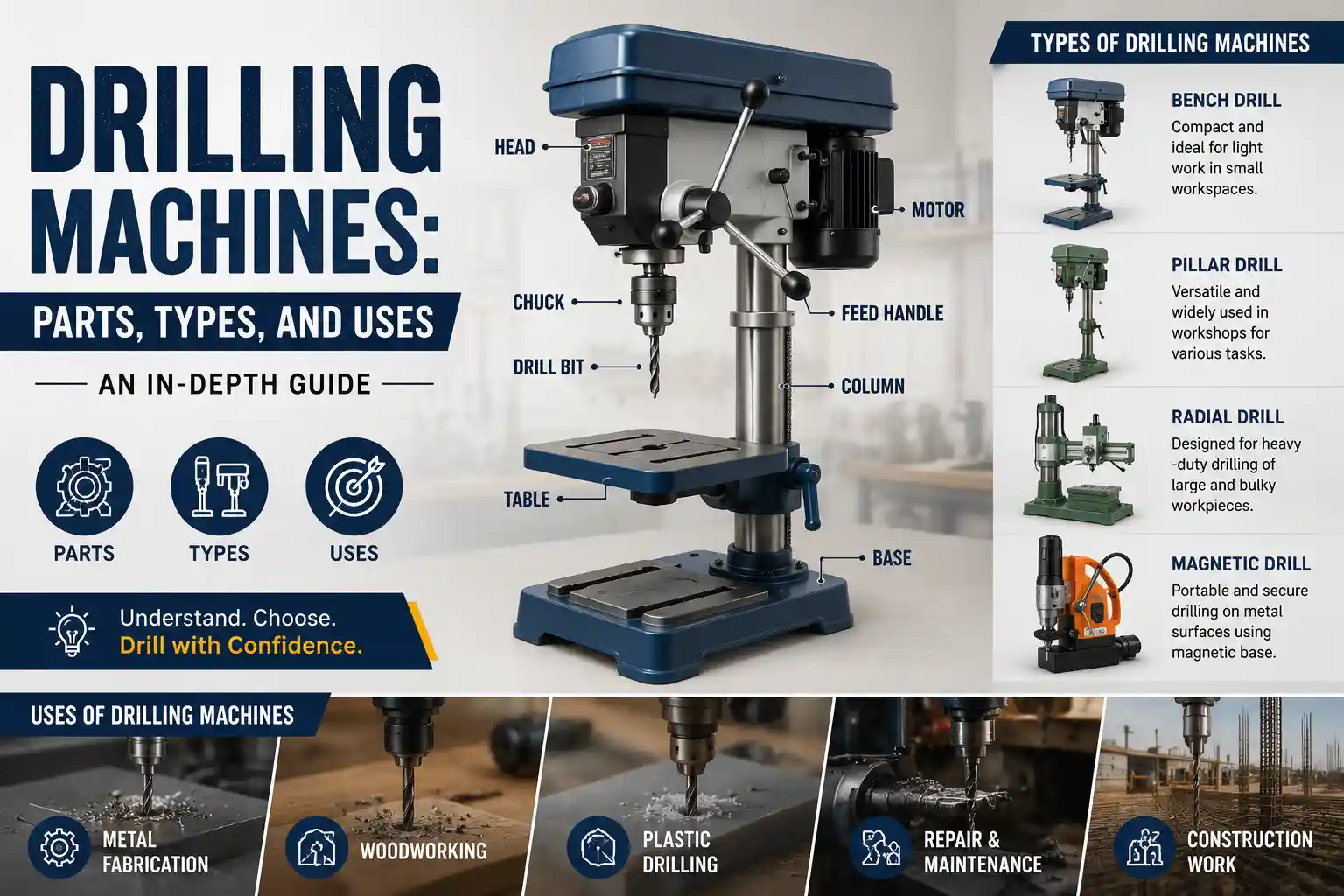
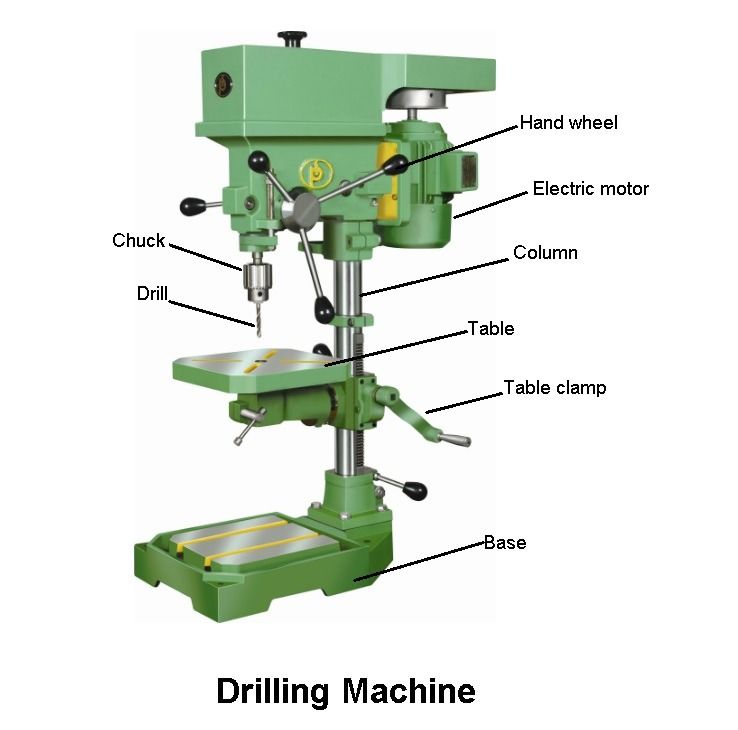
Knowledge of parts and types of drilling machine with their classification, applications is a core concept for every professional, be it a machinist, engineering student or manufacturing professionals. The drilling machine is one of the commonest machine tools in a workshop. Because of its unparalleled ability to make precise, clean holes into virtually any material metal, wood, plastic or composite it is a mainstay for everyone from automotive manufacturers to electronics assemblers.
This complete guide has it all: the definition of a drilling machine, its working with how to use a drilling machine efficiently, detailed description of drilling machine parts, types of drilling machines and real-life applications in business all in one place!
What is a Drilling Machine?
Drilling machine: A drilling machine is a type of machine tool which works on the principle of rotating a cutting tool called a drill bit against a workpiece that becomes fixed or clamped. Under combined rotational and axial (downward) pressure, the drill bit cuts into the surface, churning out chips; for a hole of predetermined diameter and depth.
Drilling Machine Definition
The official definition of a drilling machine in mechanical, is the following: A machine tool that holds a rotating cutting tool (drill bit) in a spindle and feeds it axially into its stationary workpiece to create holes of circular cross section.
From Manual to Automatic and CNC drilling machines Initial prototypes were based on hand cranks or foot pedals. Today the range of modern drilling machines varies from small bench-top drill presses in low-volume workshops to large multi-spindle CNC drilling systems in aerospace and automotive production lines.
In terms of common usage in a workshop, the term drill press may refer to either the machine itself (the vertical type usually found as bench or floor standing).
Uses of a Drilling Machine
It is essential to master the parts and way of its working by understanding the applications of a drilling machine. Almost every industry from material cutting and assembly utilizes drilling machines.
- Manufacturing and Engineering: Drilling machines make bearing mounting holes, bolt holes and heat dissipation openings in metal components and composite components. They are basic machines in developing mechanical components.
- Automotive and Shipbuilding: Engine blocks chassis frame with structural panels demand careful drilling of holes to fasteners, fuel lines, and rivets. Drilling machines provide the necessary positional accuracy and repeatability required by these applications.
- Electronics and PCB Production: Micro drilling machines penetrate printed circuit boards (PCBs) with dense hole patterns as small as 0.1mm in diameter to allow the insertion of components and electrical continuity between layers.
- Construction: Perforation-type drilling devices drilled into concrete walls, slabs, and structural steel for pipeline installation places, ventilation systems, and support screws
- Molds and Dyes: Injection molds can require cooling channels drilled to tight tolerances often controlled within ±0.05mm, so high precision drilling machines are crucial for this application as well.
- woodworking and furniture: Bench drill press is mainly used for woodworking like driller dowel holes, hinge mounting and some patterns in wood forms.
You can also check this out Power Tool Battery Standardization: All Tool Brands, One Battery
How a Drilling Machine Works
To get an idea about drilling machine parts, you should first have a basic understanding of how it works.
The motor spins and the spin gets communicated to the shaft by utilizing pulleys, belts or gears. The spindle is attached to the chuck, which tightly grips the drill bit. When the machine is turned on, the spindle and therefore also the drill bit rotates at a specific speed (rotation n) in revolutions per minute (RPM).
With downward axial pressure, either through the use of the feed handle or auto-feed mechanism, which sends the rotating drill bit deeper into the work surface. When the bit penetrates the material, its cutting edges slice away material in spiral chips that are carried up, away from the cutting zone, in the flutes of the drill bit. This creates a hole that is a clean, round shape of the diameter of the bit.
Spindle speed selection is key: steel, for instance, responds better to lower RPM and higher torque but the same drill can bore holes through softer media like wood or aluminum at much higher speeds.
Parts of a Drilling Machine
This is the most in-depth and technical part of this guide. You must know every drilling machine part what it does, where you will find and how to maintain it if you are to operate the drill safely. Drilling machine components operate as an integrated system; misalignment or failure of any component affects the performance of a complete machine.
Here is the complete break-down of all the big parts of a drilling machine.
1- Base
Base: This is the lowest structural part of the drilling machine. This can be placed directly on the workbench or floor and serves to give the entire machine a stable, vibration-insensitive base. The bases are usually of cast iron because of its very good damping capacity and the high compressive strength.
The surface of the base often has T-slots or clamping grooves machined in it so that when a vise is not used, the workpiece can be directly bolted to the table. A heavy, well designed base that resists flex and other instability is critical flex or other destabilization at the base means inaccuracy at the drill bit.
2- Column (Pillar)
The column is what propels you upwards out of the base, and supports everything above it: table, drill head, motor. For the most part, drilling machines the column; is a steel or cast-iron post either precision-ground round – or box-section.
The table and drill head travels on the column and can be adjusted vertically to fit different heights of workpieces. To get holes drilled true and straight, you want the column to be vertical (i.e. perpendicular to the base).
3- Worktable
The worktable is a horizontal platform located between the column base and drill head. It prevents the drill bit from damaging the workpiece. The vast majority of work tables can be raised, lowered, and swiveled about the column for exact placement of the workpiece directly under the spindle.
T-Slots are built into worktables to hold workpieces in place using machine vises or strap clamps, also preventing unsafe workpiece rotation caused during drilling. In addition, on radial arm drilling machines the table is also moved horizontally.
4- Drill Head
The drill head (also for rotary drills: spindle head or drilling head) is the main functional unit of the machine which contains spindle, chuck and feed mechanism. This is mounted on a column and adjustable in height. The head can be moved horizontally, on CNC and radial drilling machines.
Within the drill head is the quill, a cylinder which holds and guides the spindle as it moves up and down during feed stroke.
5- Spindle
The spindle (the rotating shaft that acts as the center of a turning machine and one of the most important drilling machines parts). It carries the rotational power from the motor all the way to chuck and drill bit. The quill contains the spindle and translates axially when turning the feed handle.
Spindle speed can be adjusted by using stepped pulleys and belt changes on manual machines or through electronic variable-speed drives on modern machines. The spindle shall be aligned to that squareness; any spindle run out (wobble) is considered as an over size hole, incorrect positioning and further wear drill bit.
6- Chuck
The chuck is the clamping device that grips the drill bit at the base of the spindle. It is one of the most used drilling machine parts and has to be cleaned and working properly.
Two main types are used:
- Keyed chuck wrenching up and loosening using a separate chuck key. Holds very securely, especially for larger drill bits.
- Keyless chuck hand-tightened Easier for fast bit changing but larger bits will slip under heavy load.
Chucks are rated according to the maximum shank diameter of drill bit they can grip, which typically is 13mm (1/2″ capacity) or 16mm (5/8″ capacity).
7- Drill Bit
Since the next step of this discussion is the drill bit, you have to know that here we mean by drilling tool indeed cutting tools. It is not a stationary machine part but rather a consumable, but it is the business end of the whole operation. There are many types of drill bits available:
- Twist Drill Bits the most common type, which use spiral flutes to evacuate the chips
- Spade Bits flat paddle-shaped bits for quick boring in wood
- Conical bits used to drill more than one hole diameter.
- Carbide-Tipped Bits for hard metals and masonry drilling
Drill bit material is immensely important: High-speed steel (HSS) works on most metals and wood, but cobalt-alloyed HSS handles tougher materials than standard grades of HSS; carbide-tipped bits are used for the hardest materials.
8- Feed Mechanism (Quill Feed)
The feed mechanism determines how the spindle and drill bit will descend downward into the workpiece. This is a plate and rack-and-pinion system, but on manual machines, it is pretty much controlled by the feed handle (the lever or set of levers located at the side of the drill head). In automated machines, a motorized auto-feed system moves the quill at a set feed rate.
You have to control the feed rate properly: Too fast and you overheat or break your bite; too slow and you cut inefficiently. Feed rate is finely adjusted in mm/rev on many industrial machines.
9- Motor
The electric motor acts as the driving force of the drilling machine. It transmits motion to the spindle via belts, pulleys, or gears. Motor power is rated in watts or horsepower the motors of bench drill presses are generally between 350W and 750W, while those of high spec industrial floor-standing machines can be as low as around 1.5kW but more commonly from 2kW to upwards of 5kW!
The motor needs to be correctly matched to the spindle speeds and what materials are being cut. Today, modern machines with variable-speed electronic drives can adjust speeds continuously without moving the position of the belts.
10- Belt and Pulley System (Stepped Pulley)
On belt-driven drilling machines, the operator can change speed ratios in a range of torque outputs according to how she or he moves the belt on a set of stepped pulleys on both the motor shaft and spindle. Different Step Combos yield a different spindle RPM.
Despite the domination of variable-speed electronic drives, belt-and-pulley systems are still used as reliable, low-maintenance speed-change mechanisms on medium-range drilling machines.
Types of Drilling Machines
Drilling machines are classified based on their design, size, application and automation. A complete guide on different types of drilling machines.
1- Sensitive (Bench) Drilling Machine
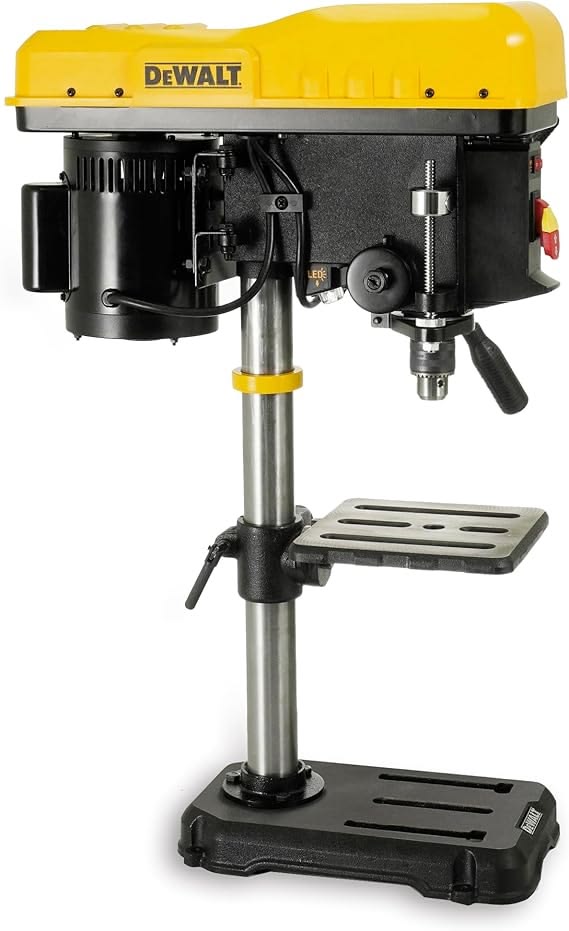
Known also as a bench drill or bench-top drill press, this common type of sensitivity drilling machine is often found in small workshops, schools and home garages. This device is set up on a workbench, powered by a small motor, and used with hand feed. The operator is “sensitive” to the cutting action via the feed lever hence the name.
Best For: Gentle drilling in materials like wood, plastic and softer metals up to around 15mm.
2- Upright (Vertical) Drilling Machine
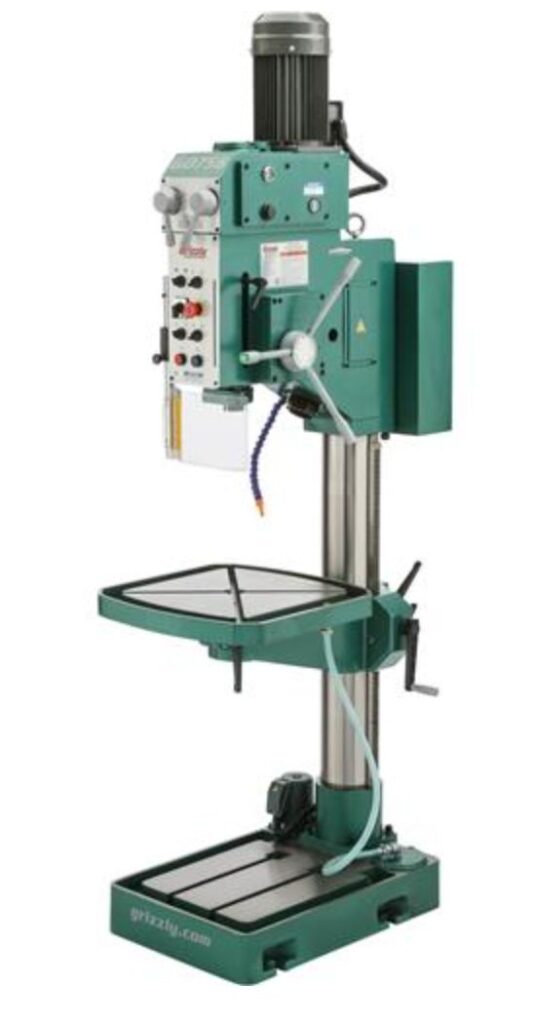
An upright machine drill is actually a bigger floor standing version of the bench drill. It features a more powerful motor, superior spindle travel, a larger worktable, and most of the time an auto-feed feature. This is a higher volume processing machine than the bench type handling both a wider range of materials and larger drill diameters.
Best for: medium to heavy duty production drilling in metal fabrication shops and manufacturing plants.
3- Radial Arm Drilling Machine
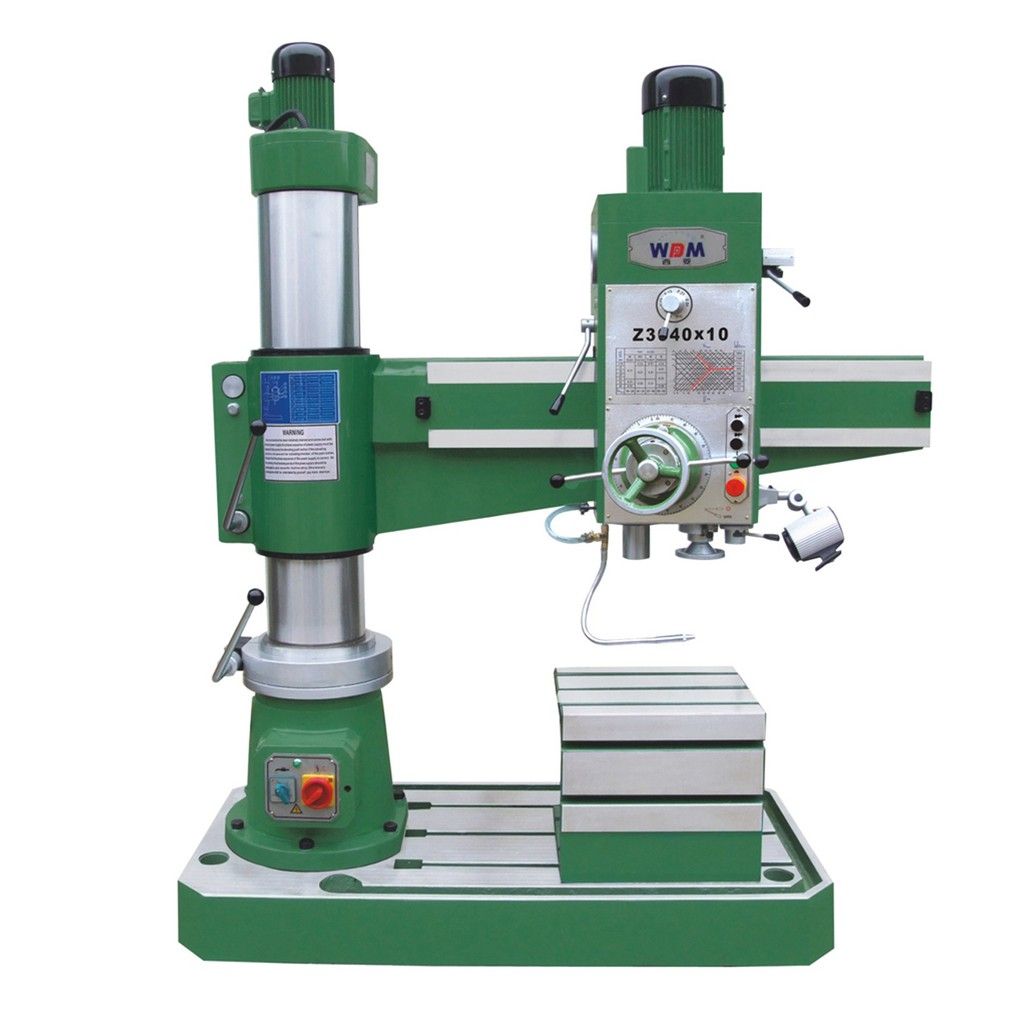
A radial arm (radial drilling) machine has the drill head on a horizontal arm which can move in an arc along the vertical column. The head also moves along the arm, so that the operator gets an ability of setting a drill anywhere over a big construction without moving it.
Ideal for: drilling large, heavy workpieces like engine blocks and machine bases but also structural steel components.
4- Gang Drilling Machine
Definition: A gang drilling machine comprises multiple drill heads (spindles) mounted parallel on a single base and table (each is driven separately). The workpiece passes from one spindle station to another, where each facility undertakes a distinct operation (drilling, reaming, countersinking).
Ideal for: high-volume applications requiring multiple sequential hole processes on the same part.
5- Multi-Spindle Drilling Machine
While gang machines use spindles operating one after the other, multi-spindle drilling machines are equipped with multiple spindles that receive motion at the same time via a single motor. All holes from a known pattern are drilled at once, vastly improving throughput.
Ideal for: high-volume components with repetitions in hole patterns such as flanges, PCBs, and engine cylinder heads.
6- Pillar Drilling Machine
Pillar Drilling Machine The pillar drilling machine is similar to the upright type except that it has a tall, stout column (pillar) to take very large and heavy workpieces, held on the floor instead of by the table. You have more vertical clearance, and higher torque.
Best For: drilling mill and large fabricated structures, agricultural equipment frame, and heavy industrial components.
7- CNC Drilling Machine
A CNC (Computer Numerical Control) type drilling machine provides the means for preparing instructions to position, speed of spindle and feed rate. This allows the machine to drill complex hole patterns with remarkable repeatability and accuracy, without manual repositioning of the workpiece.
Suitable for: precision manufacturing, aerospace part production, and electronic PCB creation, as well as any application where a precise hole must be drilled in the same place on many duplicate parts
Summary
Drilling is one of the most important and versatile manufacturing tools, construction equipment or engineering machines. In short, in this guide you can review the highlights of:
- According to the drilling machine definition, they are classed as a type of machine tool that uses a rotating drill bit to cut materials in solid phase by applying rotational and axial cutting force.
- The parts of the core drilling machine are the base, column, worktable, drill head (drilling unit), spindle, chuck & drill bit which plays a specific role and are interdependent.
- Drilling machine types range from sensitive/bench drills, upright drills, radial arm drills, gang drills, multi-spindle and pillar drills to CNC drilling machines; with each optimal for specific workpiece shapes as well as production volumes.
- Applications vary widely from home workshop and woodworking to PCB manufacturing, automotive engineering and aerospace production.
In-depth knowledge of how each drilling machine part works will help operators in using the machine effectively, speeding up troubleshooting and maintenance procedures, and also making sound purchasing decisions. Whether you are installing components in a new workshop or developing an existing production line, selecting the right type of drilling machine and taking care of its parts correctly is essential for producing consistent accurate results.
You can also check this out Top AI Tools in 2026 (Free & Paid) – Full List
FAQs
1: What is the difference between boring and reaming? Boring enlarges a pre-drilled hole with precision; reaming improves its roundness and surface finish.
2: Can portable drills perform precision work?
They can, but fixed or CNC machines are better for high-accuracy and repeatable tasks.
3: What materials can drilling machines handle?
Metals (steel, titanium, aluminum), plastics (acetal, ULTEM), composites, and some ceramics.
4: What is a common feed mechanism for drilling?
Manual lever feed in sensitive machines; motor-driven power feed in upright and CNC drills.