
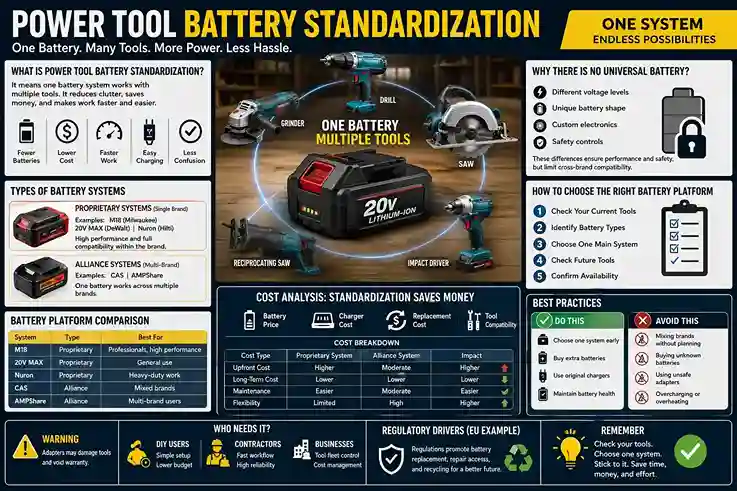
What Is Power Tool Battery Standardization
Standardization of power tools implies that a single battery system is used with numerous tools. It assists users to save a lot of various batteries and chargers.
Lithium-ion battery packs are used in most tools nowadays. These packs have a Battery Management System, which manages safety and power.
No universal battery fits all brands. Systems are designed with different tool brands in mind. voltages and fits.
Why Battery Standardization Matters
Many real problems are addressed by battery standardization.
Key Benefits
- Reduced number of batteries to control.
- Lower long-term cost
- Quickened job site work.
- Easy charging setup
- Less confusion
Example
A contractor with a single battery system can change the batteries to drill, grinder, and saw instantly.
Why There Is No Universal Battery
This is a simple question posed by many users. Why not one battery to all tools? Design and control is the answer.
Every brand develops its system with:
- Different voltage levels
- Unique battery shape
- Custom electronics
- Safety controls
This prevents performance and safety but restricts compatibility.
Types of Battery Systems
Proprietary Systems
These are a part of a single brand.
Examples:
- M18 Milwaukee Tool.
- 20V MAX by DeWalt
- Nuron by Hilti
These systems have high performance and complete compatibility within the brand.
Multi-Brand Alliance Systems
These permit a single battery with numerous brands.
Examples:
- The Cordless Alliance System (CAS) offers a range of cordless tool options.
- AMPShare
These systems assist users of tools of other brands.
Regulatory Standardization
Change is also driven by governments to promote standardized batteries.
EU Batteries Regulation is concerned with:
- Battery replacement
- Repair access
- Recycling
This enhances usability in the long run.
Battery Platform Comparison
| System | Type | Best For |
|---|---|---|
| M18 | Proprietary | Professionals often prefer tools from established tool manufacturers for reliability. |
| 20V MAX | Proprietary | General use. |
| Nuron | Proprietary | Heavy work. |
| CAS promotes collaboration among various power tool brands. | Alliance | Mixed tools. |
| AMPShare | Alliance | Multi-brand |
How Power Tool Batteries Work
There is a battery system that consists of:
- Cells (energy storage)
- BMS (control system)
- Housing (physical design)
- Terminals (power transfer)
Key Specs
- Voltage (V) → Consider the compatibility of proprietary batteries power level
- Amp hours (Ah) → run time
- Compatibility → system match
Battery Compatibility Rules
Check these rules before you make a purchase of power tool brands.
Always Check:
- Same brand or alliance ensures standardized batteries for better performance
- Same platform name
- Charger match
- Tool support
Never Assume:
- Equal voltage = equal battery
- Same shape = safe use
How To Choose The Right Battery Platform
Use this easy procedure
Step 1: Check Your Current Tools
Name all tools you possess
Step 2: Identify Battery Types
Battery system group tools
Step 3: Choose One Main System
Select the system that has the highest number of tools
Step 4: Check Future Tools
Ensure the platform is compatible with your succeeding tools
Step 5: Confirm Availability
Check local stock and service support
Decision Framework
Select proprietary system when:
- You wear one brand predominantly
- You desire good performance
- You desire easy installation
Select alliance system when:
- You use many brands
- You want flexibility
- Less batteries you desire
Cost Analysis
Standardization of batteries saves on cost in the long run
Cost Factors
- Battery price
- Charger cost
- Replacement cost
- Tool compatibility
Simple Breakdown
| Cost Type varies depending on the battery technology used. | Impact |
|---|---|
| Upfront costs can be higher for tools using proprietary batteries. | Higher |
| Long-term | Lower |
| Maintenance | Easier |
Lifecycle Cost vs Purchase Cost
There are a lot of users who are price conscious.
But actual cost consists of:
- Battery Life of cordless tools can be affected by incompatible batteries
- Replacement cycles can vary significantly among different brands
- Charger needs
- Downtime
A low-cost battery system will be expensive in the future.
Who Needs Battery Standardization
DIY Users
- Fewer tools
- Lower budget
- Need simple setup
Contractors
- Many tools
- Need fast workflow
- Want reliability from your tool manufacturers?
Businesses
- Manage tool fleets
- Need cost control
- Need standard systems
When To Switch Battery Platforms
Switch when:
- You have mixed batteries
- You have compatibility problems
- You intend to increase tools
- Your system is old
Global Considerations
Depending on the region, the battery systems differ.
Important Factors
- Availability
- Warranty support
- Import options
- Counterfeit risk
- Counterfeit batteries are typical
- Support may vary
Always purchase with reliable vendors.
Common Mistakes
Avoid these errors.
- Buying random batteries
- Ignoring platform names
- Using unsafe adapters
- Making selections by price alone
Warning
Adapters may destroy equipment or invalidate warranty.
Pros and Cons
Pros
- Simple workflow
- Reduced cost in the long run
- Better tool management
Cons
- Brand lock-in
- Limited cross-use of cordless tools can be a technical challenge
- Higher initial cost
Best Practices
Do This
- Select a single system at an early stage
- Buy extra batteries
- Use original chargers
- Maintain battery health
Avoid This
- Combining brands without strategizing
- Buying unknown batteries
- Overcharging or overheating
Conclusion
Standardization of power tools assists you in being quicker and smarter. It minimizes the amount of clutter, minimizes cost, and enhances efficiency.
A universal battery is yet to be found. Good options are provided by strong platforms and alliances. Checking your tools choose one system stick to it this small measure will save years of time, money and effort.
FAQs
1- Can power tool batteries be interchanged?
No. The majority of batteries are interoperable within the same brand or alliance.
2- Does power tools have a universal battery?
No. Every brand has its system.
3- What is the best battery system?
It is based on your requirements and resources. Select one system and keep to it.
4- Am I able to use the same battery on all the tools?
Yes, provided that tools are on the same platform.
5- What is wrong with tool batteries being universal?
Their use cannot be universal due to different designs, safety systems, and brand control.
6- Which is the most appropriate system of contractors?
Power systems or alliances systems are best.
7- Are different brands really compatible with each other? battery adapters safe?
No. They may destroy equipment and make it less safe.
8-What can I do to save money on batteries?
Make your system standard and do not mix brands.